

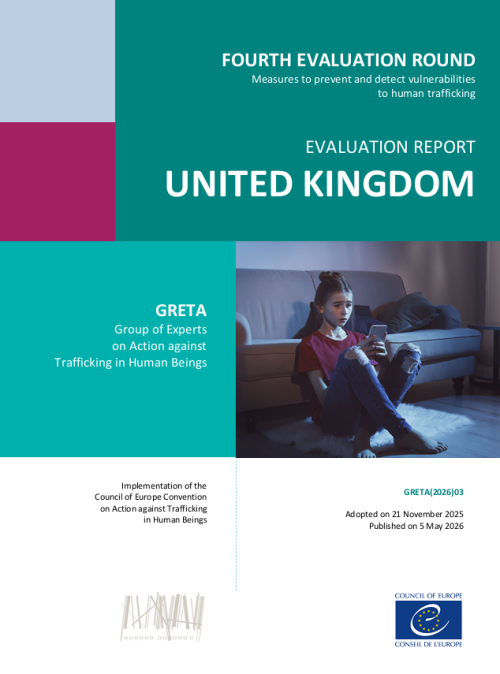
The Group of Experts on Action against Trafficking in Human Beings (GRETA) has released its latest report assessing the UK’s implementation of the European Convention on Action against Trafficking in Human Beings. In this blog, the Anti-Trafficking Monitoring Group Coordinator discusses the importance of this international treaty in the fight against human trafficking and modern slavery.
Human trafficking and modern slavery are serious violations of fundamental human rights, including liberty, security, and dignity. They encompass different forms of exploitation, such as labour exploitation, sexual exploitation, domestic servitude, and others, affecting people in the UK and worldwide. These abuses can occur across any industry and impact individuals of all ages, genders, and backgrounds.
Perpetrators often operate through organised and adaptable methods, exploiting gaps in social, economic, and immigration systems. In a world shaped by hostile immigration policies, deep inequality, conflict, and climate change, some groups are particularly marginalised and pushed into precarious conditions. When support for these individuals is denied, limited, or difficult to access, those risk factors deepen, creating the conditions in which exploitation thrives.
This reality underscores why a whole‑system response that is human rights‑based and survivor‑centred is essential to tackling human trafficking and modern slavery.
International treaties, such as the Council of Europe Convention on Action against Trafficking in Human Beings (ECAT), play a critical role in shaping these protections. They establish legally binding standards for States, ensuring that survivors’ rights – and access to identification, support, and long‑term recovery – are placed at the centre of anti‑trafficking efforts. These agreements also create accountability mechanisms that encourage countries to strengthen their systems and continuously improve how they protect survivors.
These principles, and the importance of this approach, are clearly outlined in ECAT.
The implementation of the European Convention on Action against Trafficking in Human Beings in the UK
The UK ratified the Convention on 17 December 2008, and it came into force on 1 April 2009. ECAT’s implementation by State Parties is overseen by the Group of Experts on Action against Trafficking in Human Beings (GRETA), an independent monitoring body established under Article 36 of the Convention, which began its work in February 2009.
Since then, GRETA has carried out five‑year evaluation cycles to assess the UK’s implementation of the Convention and make recommendations to improve its application. The fourth‑round evaluation explores vulnerabilities to human trafficking and, following the UK Government’s response to the assessment questionnaire and GRETA’s visit to the UK in December 2024, GRETA has published its report today.
The report will now be submitted to the Committee of the Parties to the Convention, which will adopt the recommendations. The UK will then be expected to implement them and follow up with a progress report explaining how this is being done.
These evaluations play a crucial role in refocusing attention on the UK’s efforts to address modern slavery. They bring together government departments, civil society organisations, lived experience experts, and legal specialists to provide updates on systems for identifying, supporting, and protecting survivors, as well as on access to justice and effective remedies.
As part of this process, the Anti‑Trafficking Monitoring Group (ATMG) – a coalition of 15 anti‑trafficking organisations hosted and chaired by Anti‑Slavery International – closely supports GRETA in each round of evaluation.
The importance of ECAT and its direct incorporation
ECAT remains only partially incorporated into UK law, with a limited number of obligations brought into force through procedures and policy. While the National Referral Mechanism (NRM) – the UK’s framework for identifying and supporting survivors of trafficking and modern slavery – has been implemented, few survivors’ rights have been embedded in primary legislation.
Certain aspects of ECAT have also been narrowed and, in some areas, made nearly inaccessible by recent laws such as the Nationality and Borders Act (NABA) 2022, which has restricted access to identification and specialist support.
Without directly and fully incorporating ECAT, the UK cannot effectively embed crucial human rights standards in policy decision‑making. This leaves the UK open to potential breaches of human rights, and with weak processes to hold the State accountable, it will continue to fail individuals who face discrimination and are most at risk in our society.
International commitments and robust national support structures are deeply connected. When survivors are protected, empowered, and able to rebuild their lives free from harm, societies become more resilient, and perpetrators have fewer loopholes to exploit. ECAT and other international treaties, such as the European Convention on Human Rights (ECHR), alongside practical support and protection systems, remain essential tools in the global fight against modern slavery.
This is a critical moment for the UK’s response to modern slavery, and it must take the recommendations from the GRETA report seriously.
See the full report.


