

By Enda Yuliana
Each year on 8 March, International Women’s Day challenges us not just to acknowledge inequality, but to dismantle the systems that sustain it and to stand with those whose rights are still denied.
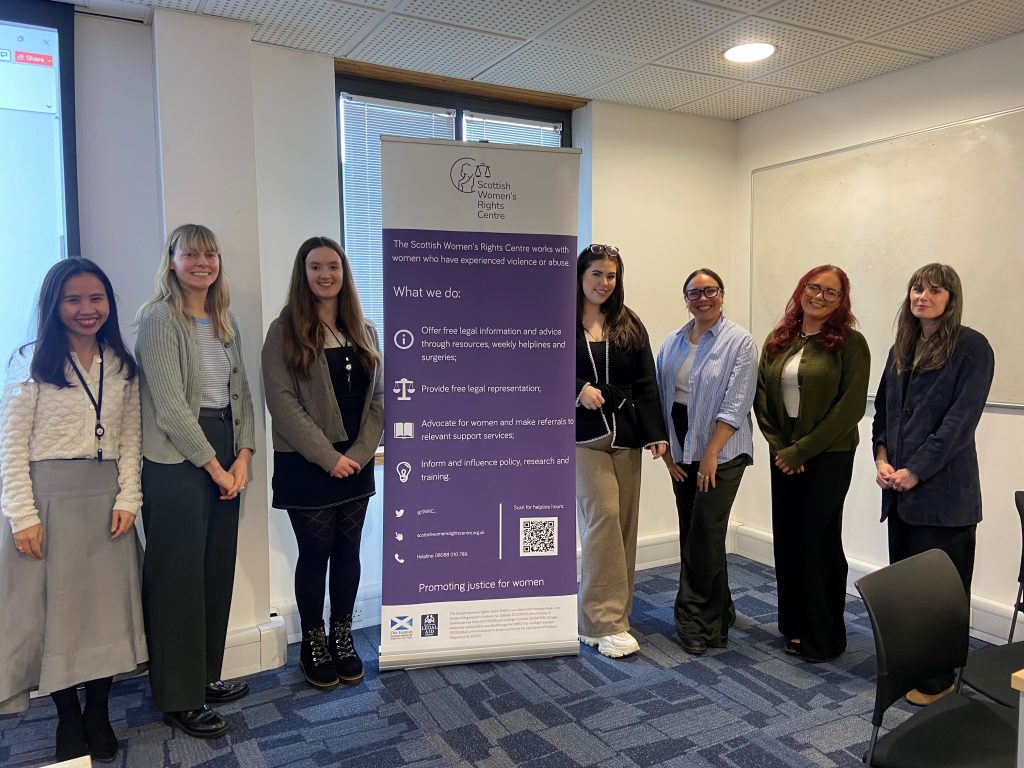
This year, on 4 March, the Scottish Women’s Rights Centre (SWRC) and the University of Strathclyde Law Clinic marked the occasion by organising a panel event that felt both timely and necessary. The theme was Gender-Based Violence as a Spectrum Issue, and the question at its heart was one we keep coming back to: How do everyday sexism, structural inequality and harmful norms connect to harassment, abuse and violence, and what does recognising that spectrum mean for law, health, advocacy and community responses?
The event organised and led by students from the Law Clinic was chaired by Laura Nairn, Solicitor at the SWRC, and opened with a welcoming address from Professor Adelyn Wilson, Head of the Law School. She set a reflective tone from the start, speaking about the importance of working across sectors and the value of initiatives like the Strathclyde Law Clinic and its partnership with JustRight Scotland in making joined-up, justice-focused work possible. Framing Gender-Based Violence (GBV) as a spectrum issue, she reminded us, is not just an academic exercise. It is a commitment to connecting the everyday with the extreme, and to understanding how normalised sexism and structural disadvantage create the conditions in which abuse and violence can take root.
Speaker Reflections
Amy Woodcock: The Invisible Spectrum in Immigration
Amy Woodcock, Trainee Solicitor at Latta & Co Solicitors, drew attention to the ways GBV shows up within immigration processes. Often invisibly, and in ways that have become thoroughly normalised.
Women navigating the immigration system can face layers of harm that are rarely named as GBV. Dependency on a partner’s visa status creates profound power imbalances. The Home Office’s requirement for consistency across repeated interviews can be deeply re-traumatising for survivors, particularly where accounts have been shaped by trauma, cultural differences or language barriers. Amy also raised the concept of culture cancellation, the erasure or disbelief of a woman’s cultural context, and highlighted the economic dependency that leaves many migrant women unable to access safety or justice independently.
“Access to justice must start with listening. Before we reform the law, we need to reform how we hear.”
Her recommendations were clear:
- Trauma-informed interviewing should be embedded in Home Office practice
- The political nature of asylum processes needs to be acknowledged and mitigated
- Holistic legal and welfare support should be available alongside legal proceedings
- Law reform must prioritise genuine access to justice, not just procedural compliance
Amy’s contribution was a reminder that the spectrum of GBV reaches into the architecture of bureaucracy itself, and that immigration law is a site of gender justice in urgent need of reform.
Kelsey Smith: Structural Inequality, Health and Economic Justice
Kelsey Smith, Head of Equally Safe at Work at Close the Gap, offered a compelling analysis of why Violence Against Women (VAW) cannot be separated from economic inequality. Close the Gap has spent 25 years working with policymakers, unions and employers on Scotland’s gender pay gap, and Kelsey brought that experience into a clear and grounded framework.
The gender pay gap, she argued, is not just a workplace statistic. It is a key indicator of women’s broader inequality, shaped by occupational segregation, inflexible working practices, pay discrimination baked into grading systems, and the persistent undervaluation of work done predominantly by women. Women make up 51% of Scotland’s population but remain dramatically under-represented in senior and decision-making roles. 90% of lone parents are women. Minority ethnic women face higher rates of unemployment and economic inactivity. The intersections between being a lone parent, a young mother and experiencing domestic abuse are deep and well-documented.
Central to Kelsey’s contribution was the link between poverty and VAW. VAW is both a cause and a consequence of gender inequality. 60% of those earning below the living wage in Scotland are women. Economic abuse, she noted, goes further than financial control. It involves restricting access to food, transport, employment and housing, and its long-term impact can make it far harder to rebuild a life, even after leaving an abusive situation.
She also raised the emerging picture of women’s occupational health, noting that almost 60% of those experiencing work-related stress are women, and that health and safety frameworks have historically been built around men’s bodies and experiences. Sexual harassment is a health and safety issue. It will just take time for the field to fully catch up with that reality.
Her closing point was striking. Equalising employment participation between men and women could be worth up to £17 billion to Scotland’s economy. Closing the pay gap, supporting women’s progression, and tackling violence against women are not separate agendas. They are the same agenda.
Abril Flores Rojo: Safety Before Solutions
Abril Flores Rojo, Project Manager at Kairos Women+, brought the voice of community practice and the wisdom of listening before acting.
Abril spoke about the importance of meeting women where they are. At Kairos Women+, community is not a backdrop to the work. It is the intervention itself. She was honest about one of the most challenging realities in this field: many women are simply not ready to talk about what has happened to them. The impulse to provide information or refer to services can, without care, replicate the very power dynamics women are trying to escape. What women often need first is not a service pathway, but a sense of belonging.
“Women need to feel safe before they can speak. Community is how we build that safety, not through systems, but through people.”
Isolation is one of the primary tools of abuse and one of the most significant barriers to recovery. The work of Kairos Women+ is to break that isolation through conversation, creativity and the simple act of being together. Rather than leading with anger at failing systems, Abril spoke about approaching this work with compassion and kindness, finding creative ways to help women feel seen. She emphasised the importance of being great allies: listening, adapting, and building confidence rather than dependency.
She also spoke movingly about supporting women after they have been through the justice system. A legal outcome, even a good one, is rarely the end of the journey. Helping women regain confidence, develop new skills and reconnect with their sense of self is not a supplementary service. It is justice.
Follow-up conversation
The second part of the event opened into a structured Q&A facilitated by Laura Nairn. It was a rich exchange, drawing on expertise and lived experience from across the room. A room filled with students from across the faculty and the university, alongside representatives from the third sector. Several themes came through clearly.
- Trauma-Informed Practice as a Baseline
The discussion returned repeatedly to trauma-informed approaches, not as a specialist technique, but as a basic expectation. This means understanding how trauma affects memory and communication, not requiring linear or consistent accounts, and recognising that apparent inconsistency is often evidence of trauma rather than deception. For the Home Office, legal practitioners, health professionals and employers alike, this is a prerequisite for ethical practice, not an optional add-on.
- Naming Coercive Control
The group discussed how coercive control often goes unrecognised, particularly for isolated women who may not yet have the language to name what is happening to them. Capacity building emerged as a priority: training that helps women, community organisations and frontline workers recognise controlling behaviour and understand available options.
- Building With Communities, Not for Them
Services designed without the participation of the women they serve will always fall short. Whether in legal reform, health guidance or policy, the question must always be asked: was this designed with survivors? Change built from community is change that lasts.
- Start Training Early
Several students raised the point that GBV awareness must be built into professional training from the start, for law students, social workers, health practitioners, housing officers and others. It is far harder to unlearn ingrained assumptions than to build good practice from the beginning. Bringing students into these conversations alongside experienced practitioners is part of that work.
- Cross-Sector Collaboration is Essential
No single organisation, profession or system can address GBV alone. Solicitors need community organisations. Policymakers need health practitioners. Employers need trade unions. And all of them need to listen to the women at the centre. Shared language and a genuine willingness to work across boundaries are not aspirational. They are the minimum.
This event, led and organised by students, has reminded us that the spectrum of GBV is not a theoretical concept. It is the daily reality of women navigating systems that were rarely designed with their safety in mind.
The event also showed us the depth of commitment, creativity and expertise across our sector. The work is happening, and it is being done with care.
The conversation doesn’t stop here. If something you heard at the event sparked a thought, a question, a connection, an action, or even the beginnings of an idea, let it grow. Real change happens when different sectors pull in the same direction, and when each of us decides to play our part.
At the SWRC, we are here for women experiencing gender-based violence. Whether you need support or want to find out what services are available, you can explore them here: SWRC services.


